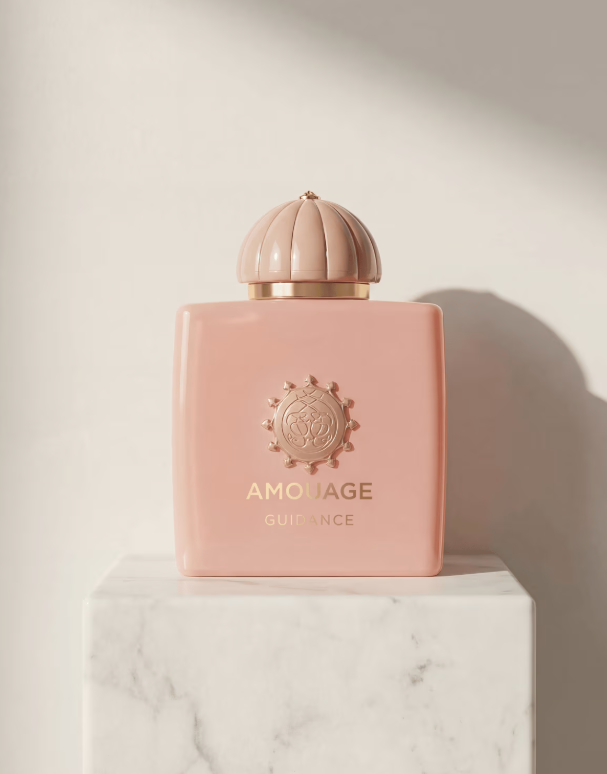
Chanel signs Chalamet. Dior has Pattinson. Armani has Galitzine. Tom Ford carries Hyun Bin across Asia-Pacific. Amouage, Le Labo, Maison Francis Kurkdjian, Liquides Imaginaires: nobody. That isn't a missed opportunity. It's a deliberate choice, and the whole character of niche grows out of it.
Billboard versus whisper
For a designer house, the bottle is the product and the actor is the ad. Millions of customers, a recognizable face, eight-figure shoot budgets. The logic is honest: to earn the spend back, the fragrance has to land on a million wrists.
Niche works on different arithmetic. Ten thousand customers with an opinion outweigh a million without one. A friend recognizes what you're wearing and asks. You quietly name the house. That's how niche grows, from a whisper, not a billboard.
What can't be sold by a face
Celebrities sell a feeling, not a smell. A face can't tell you about the iris-and-leather contrast at the centre of Santal 33. It can't explain why Amouage deliberately pushes the incense up to half the formula. That's a technical conversation, and noses lead it, not photographers.
When a star picks niche on their own
The most expensive advertising is the kind that never happened. The story that Robert Pattinson loves Baccarat Rouge 540 has been running for a decade without a cent of spend. It works because it reads as real: the actor bought the bottle because he found it, not because he signed a contract.
In the library we keep the fragrances chosen that way. Not from a poster, not from an ad, from silence.